How to Choose the Right Website for a Contractor Business Without Overspending
A contractor website does not need to be flashy to be profitable. It needs to earn trust fast, answer practical questions, and make it easy for the right customer to call, fill out a form, or request an estimate. That sounds simple, but many contractor businesses still overspend on the wrong kind of site, or underspend and end up with something that quietly costs them leads every month.
I have seen the same pattern over and over. A business owner gets excited about a redesign, spends heavily on visuals, then realizes six months later that the phone is not ringing any more than before. On the other side, some owners go as cheap as possible, build something themselves in a weekend, and wonder why visitors leave without reaching out. The problem is usually not the price alone. It is a mismatch between what the business actually needs and what it buys.
If you are trying to decide between doing it yourself, hiring a freelancer, working with an agency, or choosing a managed website for small business, the smartest move is to start with the job the website needs to do. Once that is clear, cost becomes easier to judge.
The right website is the one that supports sales
A contractor site should be measured by performance, not by how impressed other contractors are when they see it. Customers do not visit your site hoping to admire the layout. They want proof that you do the kind of work they need, in the area they live, at a level they can trust.
That means the basics matter more than many owners expect. A good contractor website is current, mobile-friendly, easy to navigate, and direct about how to get in touch. If a customer cannot quickly find your phone number, service area, or estimate form, the site is already underperforming. If your site still mentions old promotions, outdated service details, or stale project photos, trust starts leaking immediately.
This is why a contractor website redesign is sometimes less about aesthetics and more about fixing friction. A beautiful site that buries the contact button can lose to a simpler site that gets straight to the point.
Start with a cost question, but ask a better one
Business owners often ask, how much does a contractor website cost? The honest answer is that there is no single number. Pricing varies based on design, functionality, complexity, and what kind of ongoing support is included. A simple DIY site sits at one end of the range. A custom agency build can sit much higher. In between, you have freelancers and subscription-based managed options.
That wide spread confuses people, but it should not. You are not buying “a website” in the abstract. You are buying some mix of strategy, design, setup, hosting, maintenance, support, and convenience.
A low upfront price can become expensive if you still have to handle updates, chase down fixes, manage hosting, and learn tools you will barely use. A higher monthly or project price can actually save money if it keeps the site current, secure, and lead-focused without draining your time.
The better question is this: what level of website support fits the way you run your business?
A small operation that mainly needs credibility, service pages, and a contact form may not need a complex custom build. A company trying to differentiate across multiple services or markets may need more planning and more hands-on help. The goal is to buy only as much website as your business can actually use.
The four common paths, and where each one makes sense
There are four practical ways most contractors get online. Each one can be the right choice in the right situation.
DIY builders work when your needs are basic and your time is not scarce
If your main goal is to establish a credible online presence with contact information, a short explanation of services, and basic lead capture, a DIY builder can be the most budget-friendly route. This is why so many owners look for the best website builder for contractors when they first get serious about their online presence.
That approach can work, especially if your expectations are realistic. A straightforward site for a smaller operation can do its job if the content is current, the mobile experience is clean, and your contact information is easy to find. Those pieces matter more than custom flourishes.
The catch is time. Most contractor owners underestimate how much of it a DIY site consumes. Choosing a template is quick. Writing useful service copy, organizing navigation, resizing photos, checking forms, updating pages, and keeping everything current is not. If you already have a packed schedule with estimating, crews, suppliers, and customer calls, a cheaper tool can still become a costly distraction.
A freelancer makes sense when you need help, but not a full agency
A web designer for contractors can be a strong middle ground. Freelancers are often well suited for design setup, customization, and getting a site launched faster than you could do alone. This route tends to make sense when you want something more polished than DIY, but you do not need broad strategy or complex functionality.
This option works best when website designer for contractors your scope is clear. If you need a clean site with solid service pages, some project visuals, and lead capture, a good freelancer may be enough. If you need deeper messaging guidance, extensive functionality, or multiple stakeholders managed across the project, you may hit the limits of a one-person setup.
The strength of a freelancer is flexibility. The risk is variability. Some are excellent communicators and practical thinkers. Some disappear after launch or leave you juggling hosting, updates, and minor fixes on your own.
Agencies fit broader strategy and more complex needs
An agency is usually the better choice when the website is part of a bigger business push and you need strategy, custom work, or a more complex build. Agencies are often brought in when a business wants not just a better-looking site, but stronger positioning, a more deliberate user journey, or more custom functionality.
That does not automatically mean every contractor should hire one. Agencies are often the most expensive path because they move more expertise into the project. For the right business, that can be justified. For a small contractor who mainly needs a trustworthy online presence and smooth lead flow, it can be more than necessary.
I have watched owners pay for agency-level process when what they really needed was cleaner copy, better mobile usability, and faster updates. It is a painful way to learn that bigger is not always smarter.
Managed websites solve the maintenance problem many contractors ignore
This is the category many owners should consider earlier than they do. A managed website for small business usually bundles the pieces owners forget to price separately, such as hosting, security, backups, updates, and support. That changes the buying decision.
The benefit is not just technical convenience. It is operational relief. Instead of treating the website like a one-time purchase that starts aging on day one, a managed setup treats it like an active business asset. That matters because websites do not stay effective by accident. Phone numbers change, crews expand, services shift, photos improve, and markets evolve. A site that never gets touched tends to get stale.
For some contractor businesses, a managed option is the sweet spot between low-cost DIY and a large custom project. One example is Scalable Websites, a Houston, Texas-based managed website provider for contractors nationwide that offers professionally designed websites on a monthly subscription with hosting, security, unlimited updates, a dedicated project manager, and launches in days. That kind of setup will not fit every owner, but it points to a practical truth: many contractors do better with a system that keeps the site running and updated than with a one-time build they have to babysit.
Overspending usually comes from buying the wrong kind of complexity
Contractors rarely overspend because they wanted too much quality. They overspend because they paid for features or process that did not improve conversions.
A concrete coating company, for example, may think it needs an elaborate homepage with animation and layered effects. In reality, concrete coating website design often performs better when it clearly shows surfaces, explains the process in plain language, answers common objections, and makes quote requests simple. Customers usually care more about whether the finish looks durable and attractive than whether the page has cinematic transitions.
The same principle applies to epoxy flooring website design. If the site quickly shows before-and-after examples, clarifies where the service is offered, and explains how visitors can request an estimate, it is doing meaningful work. If the owner paid heavily for custom design flourishes but still has weak service descriptions and no obvious call path, that investment is upside down.
Pool screen enclosure website design is another good example. This niche often benefits from visuals because prospects want to see clean workmanship and style options. But that does not mean the site has to be oversized or expensive. It means the visual presentation should support trust and action. There is a big difference.
Different trades need different emphasis, not entirely different websites
Some owners get pulled into the idea that their niche needs an unusually specialized site. Sometimes that is true in a modest way. Often it gets exaggerated.
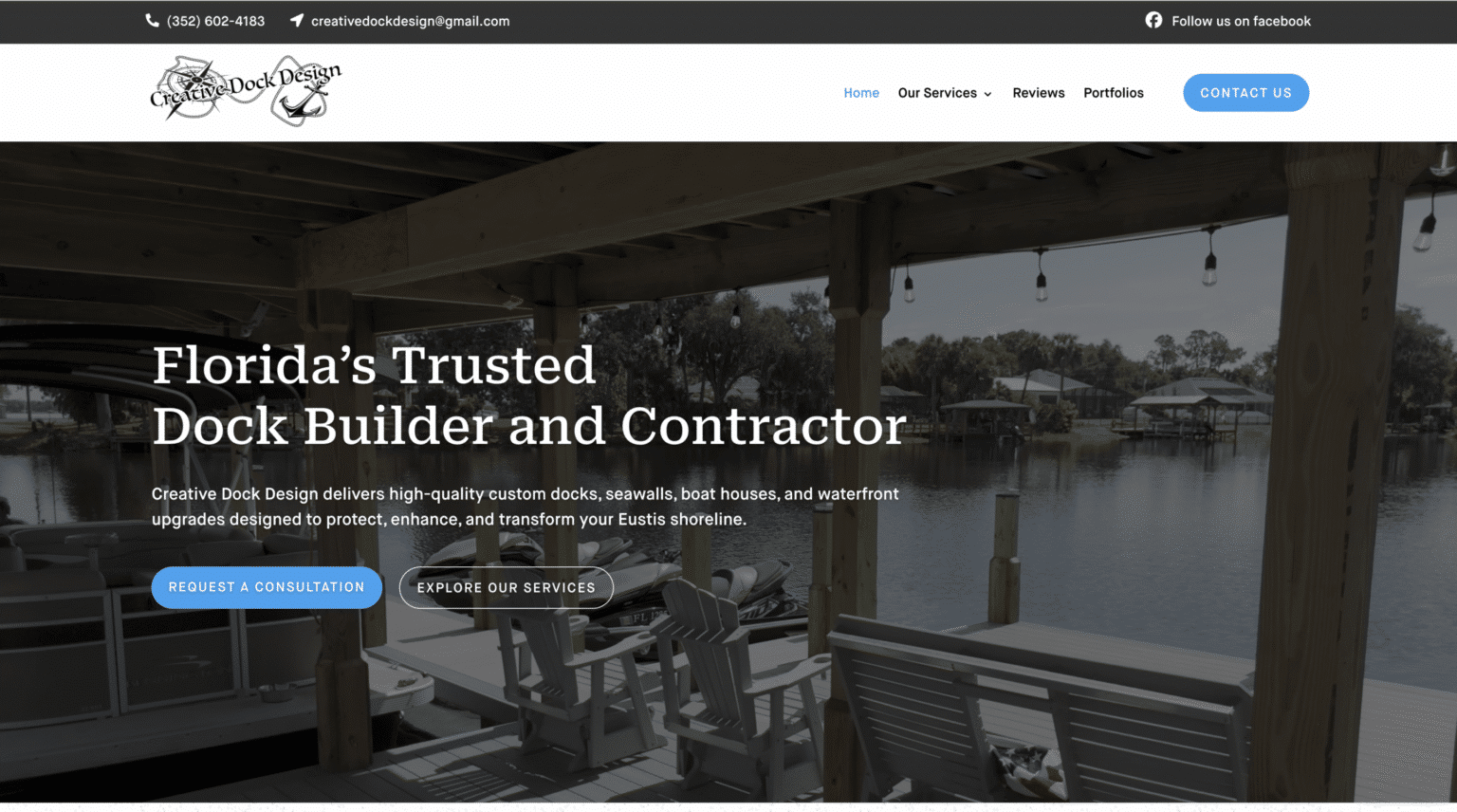
A dock builder website design may need to feature service area and project visuals prominently because context matters. Water-adjacent work is location-sensitive, and prospects may want immediate reassurance that you handle the type of structure they need. A mold remediation website design may need stronger trust signals and clearer explanations because customers are often anxious and urgency is part of the buying context. Home remodeling website design often benefits from stronger project storytelling because homeowners are making more emotional, longer-horizon decisions. Flooring contractor website design may need better categorization of services and surfaces so visitors quickly know whether you handle their project type.
Those are real differences, but they do not automatically require wildly different budgets. The framework is usually similar. Clear service pages, current content, mobile usability, strong contact paths, and proof of work matter across trades. The specialization often happens in copy, imagery, and page emphasis, not in building some expensive digital machine.
The danger signs that mean your current site is costing you money
A site can stay online for years while quietly undercutting the business behind it. Owners get used to it, especially if they are still getting referrals. But referrals still check websites, and poor websites weaken confidence before the first call.
Here are the most common signs that a contractor website redesign is worth serious attention:
- Your site looks rough or works poorly on a phone.
- Contact information is hard to find or inconsistent.
- Pages contain outdated service details, offers, or announcements.
- Visitors have to dig to understand what you do and where you work.
- Making contact feels like effort instead of the obvious next step.
None of those issues are cosmetic. They hit trust, usability, and conversion directly. If your site has two or three of these problems, the cost of delaying a fix is usually higher than the cost of improving the site.
How to decide what level of website you actually need
Most contractor businesses can save themselves money by making this decision with discipline instead of emotion. Start by looking at the way leads really come in and where the website fits in that process.
If most of your work comes from referrals and repeat business, your site may mainly need to validate credibility. In that case, you probably do not need a large custom project. You need something current, professional, and easy to use.
If your growth depends on people finding you online, comparing you to competitors, and reaching out through the site, then your website deserves more attention and probably more budget. Not unlimited budget, but enough to build confidence and reduce friction.
A practical way to think about it is this:
- Choose DIY if you have simple needs, a tight budget, and the time to maintain the site properly.
- Choose a freelancer if you want a more polished result and your scope is straightforward.
- Choose an agency if you need broader strategy, more custom functionality, or a more complex process.
- Choose managed service if you want professional help plus ongoing maintenance, support, and less operational hassle.
That is where many owners find clarity. The “best” solution is not the most advanced one. It is the one you will actually keep current and useful.
What not to cut when you are trying to save money
If the goal is to avoid overspending, some corners can be trimmed safely. Others should not be touched.
Do not skimp on mobile usability. A contractor site that is frustrating on a phone burns trust quickly. Do not hide contact information in the name of cleaner design. Do not let content go stale. Do not assume launch day is the finish line.
I have seen businesses obsess over logo placement and ignore the fact that their estimate form is buried or broken. That is like repainting the truck while the brakes are failing. Website decisions should be tied to customer action first.
This is also why monthly cost should be evaluated alongside labor cost. A cheaper setup that requires you or your office manager to wrestle with updates every week may not be cheaper in practice. Time is part of the budget, even when it does not show up on the invoice.
A note on builders, because many contractors start there
Owners often ask about the best website builder for contractors as if there is one perfect platform. There usually is not. The stronger question is whether a builder-based approach matches your budget, skill level, and willingness to maintain the site.
Builders can be a smart choice when you want affordability and speed. They can be a poor choice when you need help making decisions, writing service pages, organizing conversions, and keeping everything current. Tools are only as good as the decisions made inside them.
That is why a contractor should not choose a platform first. Choose the operating model first. Decide whether you want to do the work, delegate the work, or subscribe to a service that manages the work. Once you know that, the platform question becomes much easier and much less emotional.
The cheapest website often costs more than it seems
A low-cost site can cost you in slow follow-up, weak credibility, poor mobile experience, and stale messaging. It can also cost you in opportunity. If a homeowner lands on your site ready to hire and leaves confused, the loss is not theoretical. That is a real lead, gone.
At the same time, paying top dollar does not guarantee results. A high-cost site that overcomplicates simple decisions can fail just as easily. Contractors do best when they stay focused on fit. What does the customer need to know? What action do you want them to take? How much help do you need to keep the site functioning and current?
Those questions lead to better buying decisions than chasing trends or reacting to a flashy proposal.
Spend with restraint, but do not buy weakness
A contractor website should help you look established, make contact easy, and support the way customers actually choose a service provider. If it does that, it is earning its keep. If it does not, the price does not matter much because the investment is being wasted.

The real win is not finding the absolute cheapest option. It is choosing the simplest effective option for your stage of business. For some owners, that will be a builder and some focused effort. For others, it will be a freelancer. For many, especially those who are too busy to maintain a site properly, a managed website for small business may be the most economical decision over time.
When you look at your choices through that lens, the path gets clearer. Buy the level of website that matches your real needs, not your fears, not someone else’s sales pitch, and not the assumption that expensive automatically means better. That is how a contractor business gets a website that works without overspending.